


Can a healthcare system influenced by commercial pressures remain truly patient-centred?
That was the question at the heart of the Australian Ethical Health Alliance (AEHA) Symposium 2026, The Ethics of Profit in Medicine… Are We There Yet?
Convened by AEHA Chair Adrian Cosenza and co-moderated by AEHA Deputy Chair Susanne Tegen and Avant Chief Medical Officer Professor Steve Robson, the symposium used a live hypothetical to explore the ethical tensions that emerge when financial sustainability, innovation, patient autonomy and public accountability intersect.
Attendees heard the story of Sabra, a woman navigating social media health advice, complementary therapies, weight-loss treatments, cosmetic medicine, healthcare complications and ultimately long-term care needs, participants were challenged to examine how ethical principles hold up when tested by real-world pressures.
Through six interconnected scenes, participants explored ethical tensions at different stages of care. The scenes explored the influence of social media and online health advice, the promise of quick solutions, cosmetic and profit-driven healthcare interventions, patient vulnerability, and the challenges that arise when the consequences of private decisions ultimately become the responsibility of the public health system.
The discussion brought together perspectives from ethics, health economics, patient advocacy, clinical practice, industry, policy and health system leadership, reflecting the reality that no single sector can address these challenges alone.
While the hypothetical followed a single patient journey, the discussion revealed broader truths about trust, responsibility, patient-centred care and the increasingly complex nature of modern healthcare.
Susanne Tegen guided the audience through Sabra's unfolding journey, introducing increasingly complex ethical dilemmas that challenged participants to consider the perspectives of patients, clinicians, policymakers, industry and the broader community. Following each scenario, Steve Robson invited the panel to test assumptions, examine competing priorities and explore the practical realities of ethical decision-making in healthcare.
Trust is earned, not assumed
The symposium opened with a familiar challenge. Sabra arrived seeking advice but placed greater trust in information sourced through social media than traditional healthcare channels. Professor Steve Robson framed the dilemma:
"The problem is that she seems to trust the Instagram influencer a lot more than she trusts the medical profession."
He challenged participants to consider how healthcare professionals can maintain credibility in a world where information, opinion and marketing compete for attention.
"How is it possible for a trained and experienced general practitioner to compete with the world of Instagram and TikTok and all of those influences that are so important to so many people?”
Physician, researcher and philosopher Professor Paul Komesaroff argued that rebuilding trust requires a different approach to healthcare relationships.
"She hasn't come to be bossed around or told what to do. She's come for some kind of guidance."
He emphasised that trust cannot be assumed and must be earned.
"So how do we build trust? We build trust by being trustworthy."
For Susanne Tegen, the discussion demonstrated the value of bringing diverse perspectives together to navigate increasingly complex challenges.
"Healthcare's most difficult ethical questions cannot be solved by any one profession, organisation or sector. They require genuine dialogue, diverse perspectives and a willingness to explore complexity together."
Healthcare is about people, not problems
As Sabra's story unfolded, panellists repeatedly returned to a central theme: ethical healthcare begins by recognising the whole person. Professor Komesaroff observed that Sabra's circumstances extended far beyond a single clinical presentation.
"She's grappling with a lot of issues herself. Some of them are medical, some are physical, some of them are social, psychological and behavioural."
Reflecting on the discussion, Catholic Health Australia CEO Dr Katharine Bassett highlighted what she believed was the most important lesson of the day.
"Healthcare is, at its core, an act of accompaniment. We walk alongside people in their most fragile moments."
She challenged healthcare leaders to look beyond diagnoses and treatments.
"Too often, the question we ask is 'What's wrong with this patient?' when the more honest question is 'What has happened to this person, and who is walking with them?'"
For Louise Hardy, CEO of Arthritis Australia, the discussion reinforced the importance of designing systems around people rather than expecting people to navigate increasingly fragmented pathways.
"Healthcare works best when services are designed around people's needs, experiences and circumstances. Ethical practice requires us to continually ask whether our systems are truly serving those they were created to support."
Patients must help shape the system
The symposium also highlighted the importance of ensuring patients are not merely the subjects of healthcare policy but active participants in shaping it. Pain Australia CEO Monika Boogs emphasised the value of lived experience in healthcare decision-making.
"Trust is built when patients feel heard, respected and included in decisions that affect their lives. Ethical healthcare requires us to listen to the people the system exists to serve."
Participants agreed that maintaining trust will depend not only on what decisions are made, but who is involved in making them.
Informed choice requires informed patients
One of the earliest ethical tensions explored by the hypothetical centred on misinformation, social media and the growing complexity of healthcare information. Medicines Australia CEO Elizabeth de Somer argued that health literacy must be viewed as an ethical issue.
"Health literacy is fundamental to informed choice. Supporting people to understand, assess and use health information is critical to patient-centred care."
She noted that patients increasingly expect access to innovation and information but require support to navigate both.
"Patients want timely access to innovation, but access alone is not enough. People need the information, support and confidence to navigate increasingly complex healthcare choices."
The discussion reinforced that autonomy depends not simply on having options, but on understanding them.
Autonomy and responsibility
As the hypothetical progressed into more complex and commercially driven healthcare decisions, participants examined the relationship between patient choice and professional responsibility. Bioethicist Professor Justin Oakley observed that autonomy is an essential ethical principle, but not the only one.
"Respecting patient autonomy does not mean abandoning professional judgement. Ethical care requires partnership, where patients are supported to make informed decisions while clinicians continue to provide guidance grounded in evidence and experience."
He noted that some of healthcare's most difficult questions arise when important values come into tension with one another.
"The role of ethics is not to eliminate those tensions but to help us navigate them thoughtfully, transparently and fairly."
Healthcare is an interconnected ecosystem
One of the clearest messages to emerge from Sabra's journey was the interconnected nature of Australia's healthcare system. Her experiences crossed social media, complementary medicine, primary care, pharmaceuticals, cosmetic medicine, private hospitals and ultimately the public health system. Reflecting on the discussion, Elizabeth de Somer observed:
"When one part fails, another steps in. This interdependency is both a strength and a vulnerability."
Participants repeatedly noted that decisions made in one part of the system often create consequences elsewhere. Medibank Chief Medical Officer Dr Andrew Wilson reflected on the importance of shared responsibility.
"The ethical challenge is ensuring accountability across the whole patient journey. Decisions made in one setting can create consequences elsewhere, reinforcing the need for shared responsibility across the healthcare system."
Balancing innovation, value and sustainability
The symposium did not seek to determine whether profit has a place in healthcare. Instead, it explored how financial incentives can be aligned with patient outcomes, equity and public trust. Health economist Professor Richard de Abreu Lourenço challenged attendees to think carefully about the relationship between economics and ethics.
"The challenge is not balancing ethics against economics. The challenge is ensuring that economic decisions reflect ethical priorities."
Australian Government Chief Health Economist Professor Emily Lancsar expanded on this theme, highlighting the realities of finite resources.
"Every healthcare system makes choices. The ethical question is not whether choices are made, but whether they are made transparently, fairly and in ways that maximise value for patients and communities."
She argued that sustainability and equity must be considered together.
"A sustainable healthcare system is one that uses resources wisely while maintaining fairness, access and public trust."
From an industry perspective, Zimmer Biomet Managing Director Warren Ballinger reflected on the relationship between innovation, investment and patient benefit.
"Innovation does not happen without investment. The challenge for the healthcare sector is ensuring that commercial success and patient benefit remain aligned."
He emphasised that transparency and collaboration remain critical.
"The question is not whether profit has a role in healthcare, but whether incentives across the system consistently support better outcomes for patients."
An ongoing conversation
Closing the symposium, AEHA Chair Adrian Cosenza reflected on the broader responsibility of healthcare leaders and organisations.
"Leadership in healthcare is fundamentally an ethical endeavour."
He reminded attendees that trust remains one of the sector's most valuable assets.
"Trust is no longer a passive asset. It needs to be an active commitment."
Reflecting on the symposium, Adrian said
"the discussions stress-tested these issues in a structured but highly realistic way, drawing on perspectives from patients, academics and senior health leaders." He noted that “the debates reflected the decisions and trade-offs being made across our healthcare system every day."
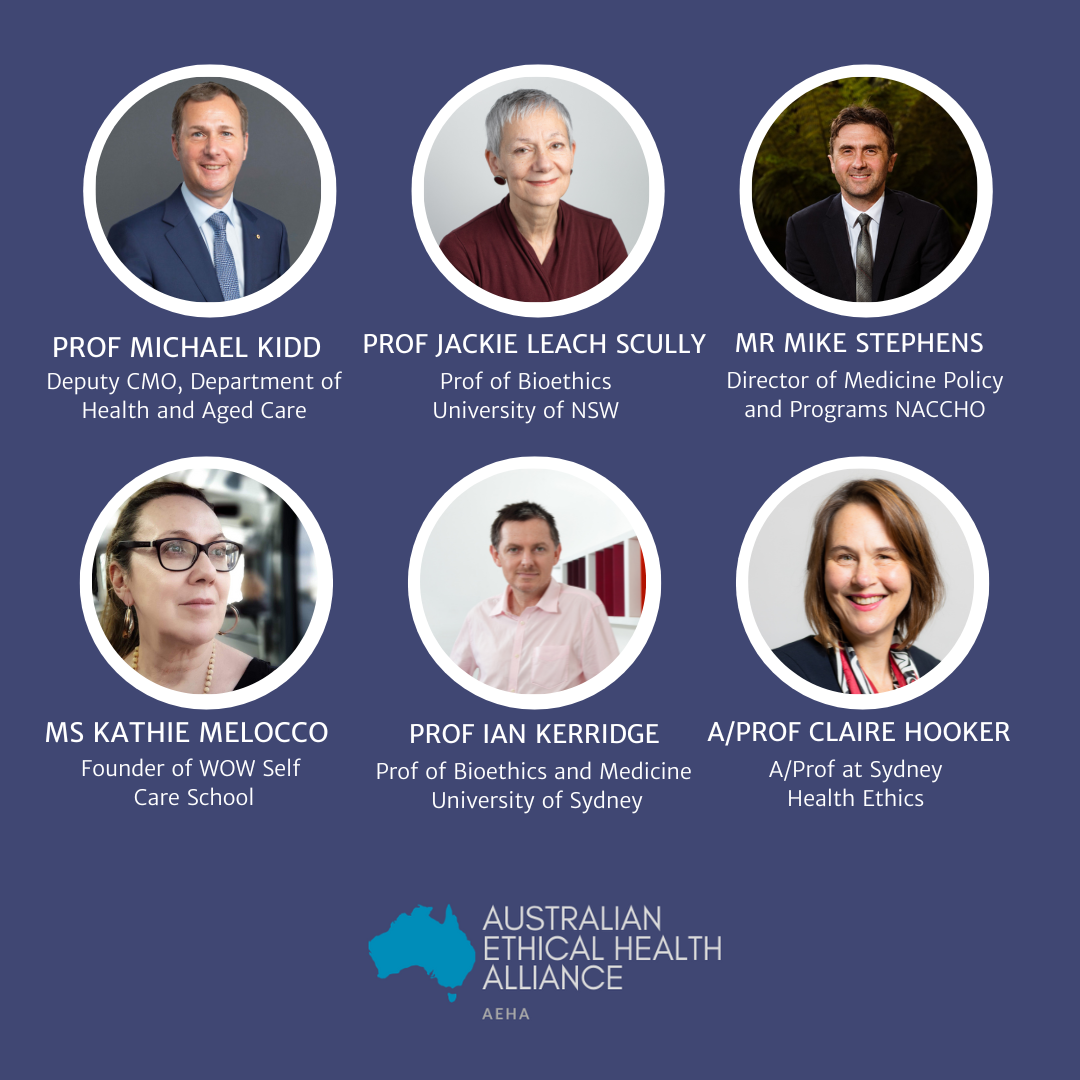
The conversation continued well beyond the formal hypothetical, with strong engagement from attendees both in the room and online. Moderated by Professor Ian Kerridge, the audience Q&A explored broader questions of professional responsibility, public trust, innovation, access and accountability, highlighting both the complexity of modern healthcare and the value of bringing diverse perspectives together to examine these challenges.
The hypothetical never set out to determine whether profit is good or bad. Instead, it revealed that trust, ethics and patient-centred care depend on how decisions are made, how incentives are aligned and whether the interests of patients remain at the centre of an increasingly complex healthcare system. The journey of a single hypothetical patient demonstrated that these challenges cannot be solved by any one profession, organisation or sector alone. They require ongoing collaboration, transparency and a shared commitment to ethical practice.The insights generated through the symposium will inform AEHA's ongoing work to strengthen ethical collaboration and public trust across Australia's healthcare sector.